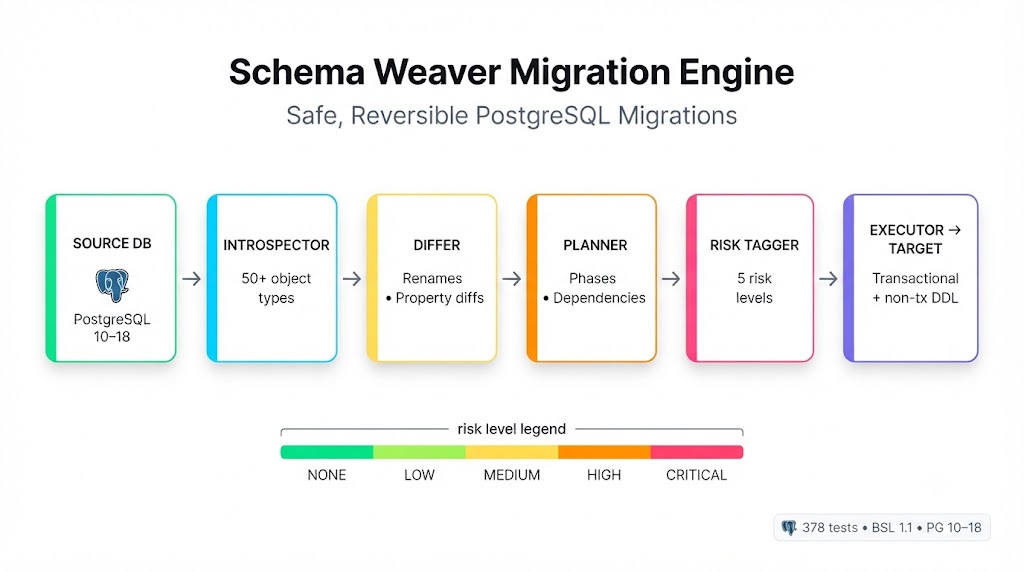
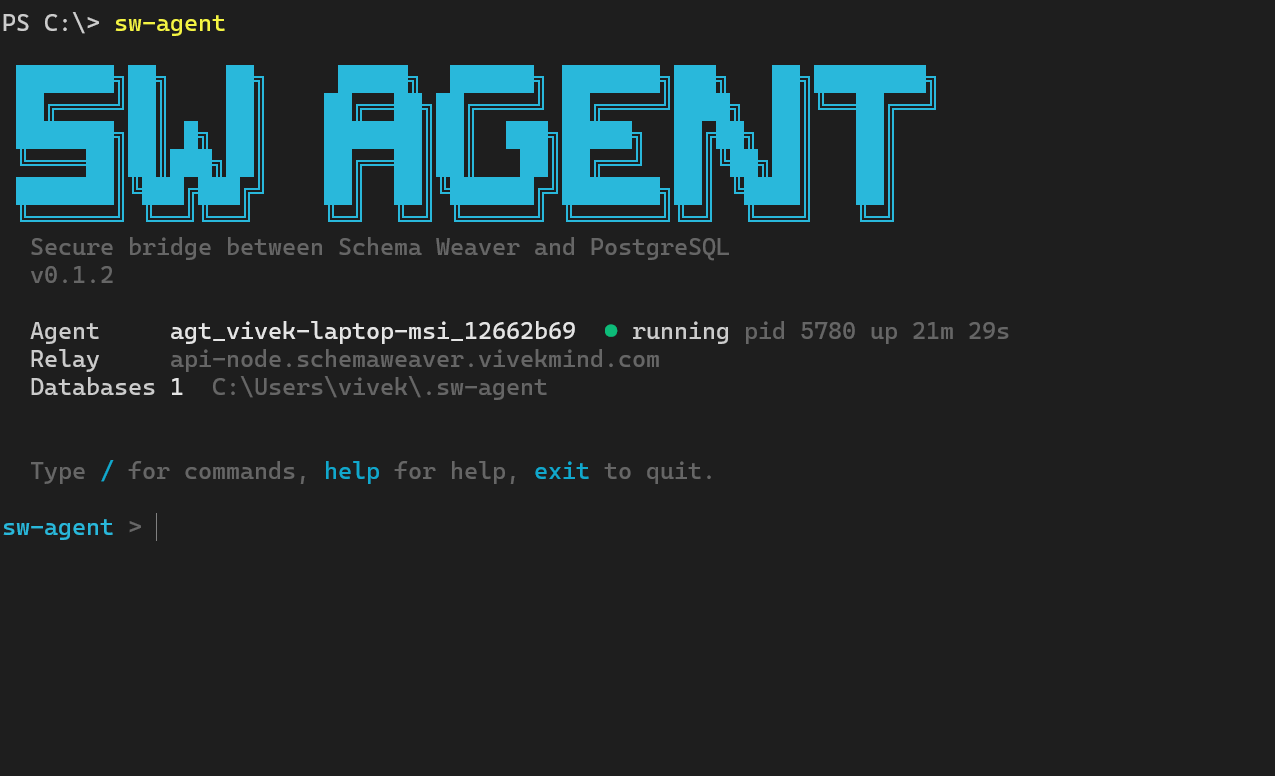
Schema Weaver Connector v2: Zero-Ingress Security, Local Credentials, and AST-Verified AI Analytics
Schema Weaver Connector v2 introduces an outbound-only daemon with Local Credential Boundaries (LCB) and Connector-Enforced Read-Only (CERO) execution—letting AI query live databases with zero inbound firewall ports and zero credential exfiltration.
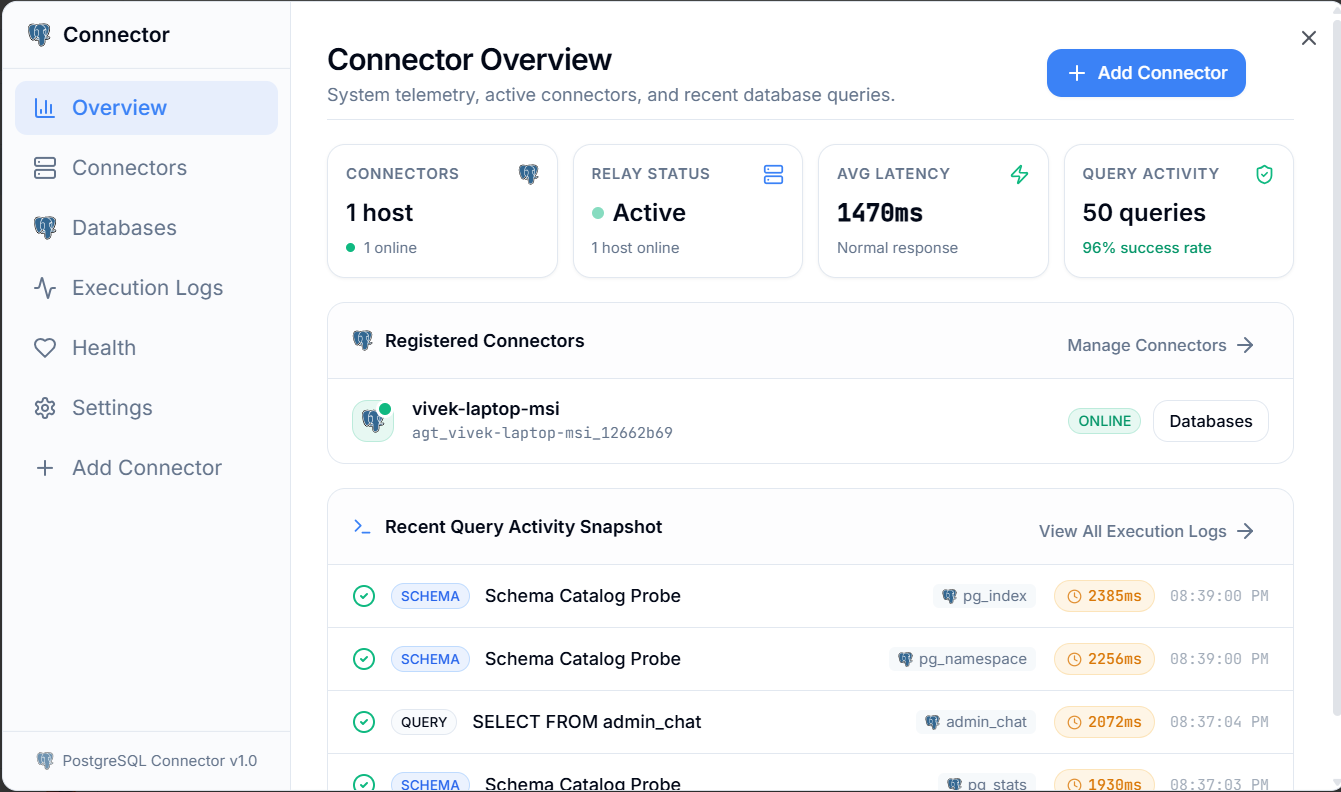
Connecting live production databases to modern AI analytics has traditionally forced an unacceptable trade-off: either poke holes in your firewall with open inbound ports, or upload your sensitive database credentials to a third-party cloud. Today, we are introducing Schema Weaver Connector v2—a complete re-architecture of how databases securely interface with cloud analytics and AI agents.
The Dilemma: Why Traditional Database Ingress is Broken
Most database visualization and BI tools were designed a decade ago. To connect your database to their cloud, they require:
- Opening Public Inbound Ports: Exposing Port
5432to the public internet, forcing you to maintain fragile IP allowlists or set up costly site-to-site VPNs and bastion hosts. - Credential Exfiltration: Storing raw database usernames, passwords, and private SSL keys on third-party cloud servers. If the provider suffers a breach, your entire database is compromised.
- Unbounded AI Execution: Entrusting database safety entirely to an LLM's prompt. If an AI hallucinates or misinterprets a prompt, there is no host-level barrier stopping a destructive
UPDATEorDROP TABLE.
Schema Weaver Connector v2 resolves this dilemma by flipping the security model on its head: credentials never leave your machine, zero inbound ports are opened, and execution safety is enforced physically on your host before queries ever touch PostgreSQL.
High-Level Architecture: Zero Ingress, Four Boundaries
The Connector is a lightweight daemon you run on any machine or private VPC that already has local network access to your database. It makes an outbound-only TLS 1.3 WebSocket connection (Port 443) to the Schema Weaver cloud relay.
graph TD
    subgraph Cloud["Schema Weaver Cloud Control Plane"]
        UI["Data Explorer & Voice Orb"]
        AI["Resona AI Engine"]
        Relay["Outbound Relay (wss://api.schemaweaver.dev:443)"]
        UI --> AI
        AI --> Relay
    end

    subgraph PrivateVPC["Your Private Environment / VPC (Zero Ingress)"]
        Daemon["pg-connector v2 Daemon"]
        LCB["Local Credential Boundary (LCB)
Passwords remain on local disk"]
        CERO["Connector-Enforced Read-Only (CERO)
AST SQL verification engine"]
        DB[("PostgreSQL Database
Localhost / Supabase / RDS / Cloud SQL / VPC")]

        Relay -. "Outbound-Only TLS 1.3 (0 Open Inbound Ports)" .-> Daemon
        Daemon --- LCB
        Daemon --> CERO
        CERO -->|Permitted Read-Only SQL Only| DB
    end
The Core Innovations in Connector v2
1. Local Credential Boundary (LCB)
Under the Local Credential Boundary (LCB), your database credentials (hostname, port, username, password, connection strings, and client certificates) remain strictly isolated on your own machine.
When you register the connector with Schema Weaver Cloud, the CLI generates two locally-scoped tokens:
Connector ID(e.g.agt_...) — Identifies the outbound relay tunnel.Connection Key(e.g.swagt_...) — A cryptographically secure secret that authorizes the tunnel connection.
Security Principle: Schema Weaver Cloud never asks for, receives, or stores your database password. The cloud has zero capability to authenticate to your database directly.
2. Connector-Enforced Read-Only Execution (CERO)
The Connector is not a passive proxy. It acts as an autonomous execution security boundary.
Every incoming SQL statement—whether entered in the data grid, requested by a teammate, or synthesized by Resona AI—must pass through the local CERO engine. The connector inspects the Abstract Syntax Tree (AST) of the query locally on your machine before running it against PostgreSQL:
sequenceDiagram
    autonumber
    actor User as User / Voice Query
    participant Cloud as Schema Weaver Cloud
    participant Daemon as Local Connector v2 (Host)
    participant DB as Customer PostgreSQL

    User->>Cloud: "What was our average order value by cohort last month?"
    Cloud->>Cloud: Resona AI synthesizes analytical SQL query
    Cloud->>Daemon: Stream query payload over outbound WebSocket
    Note over Daemon: CERO Engine parses SQL AST locally
    alt Mutation Statement Detected (e.g. DROP, UPDATE, DELETE)
        Daemon-->>Cloud: 403 Forbidden (Blocked locally at host boundary)
    else Safe Read-Only Analytical Query
        Daemon->>DB: Execute query locally using local credentials
        DB-->>Daemon: Return result rows
        Daemon-->>Cloud: Stream transient result rows (Ephemeral TLS)
        Cloud-->>User: Render live data grid, charts & voice response
    end
If an analytical statement attempts to execute DROP, DELETE, UPDATE, INSERT, TRUNCATE, or ALTER, the connector rejects the statement immediately on the host. The database is never touched.
3. Zero-Ingress Network Isolation
Unlike traditional BI setups that require you to whitelist a range of cloud IP addresses on your database firewall, Connector v2 establishes an outbound-only TLS 1.3 socket on standard HTTPS Port 443. Your firewall can safely maintain a Deny All Inbound rule.
Connector v2 also provides native support for corporate forward proxies:
export HTTPS_PROXY="http://proxy.internal.corp:8080"
export NO_PROXY="localhost,127.0.0.1,internal.corp"
pg-connector start
4. Transient Data Streaming (Zero Cloud Replicas)
Schema Weaver does not ETL, duplicate, or retain copies of your customer data in the cloud. Query result rows are streamed transiently into the active browser session or dashboard render pipeline and discarded.
Comparing Database Access Approaches
| Security Parameter | Direct Cloud BI / Traditional Tools | SSH Bastion / VPN Tunnel | Schema Weaver Connector v2 |
|---|---|---|---|
| Inbound Firewall Ports | Requires Port 5432 open to public IPs | Requires Port 22 open or VPN gateway | 0 Inbound Ports (Outbound TLS 443 only) |
| Password Storage | Stored on third-party cloud | Stored on cloud & bastion host | Local Machine / VPC Only (LCB) |
| AI Query Safety | Prompt-level trust only | Prompt-level trust only | Local AST Enforcement (CERO) |
| Setup Time | 30–60 minutes (firewalls, VPC peering) | Hours to days (VPN configs, keys) | Under 3 minutes via single CLI command |
| Team Sharing | Share raw credentials or pay per seat | Manage multiple SSH accounts | 1-Click team sharing without password exposure |
24/7 Autostart Background Daemon & Supervision
For production servers, developer workstations, and cloud VMs, Connector v2 introduces native cross-platform service supervision via pg-connector service:
# Install and configure 24/7 background autostart
pg-connector service install

# Check live daemon state and process telemetry
pg-connector service status

# Stop and uninstall the background service
pg-connector service uninstall
- Linux: Installs an isolated
systemduser unit (schema-weaver-connector.service) configured with automatic restart on unexpected exit (Restart=always). - macOS: Configures a
launchduser daemon (dev.schemaweaver.pg-connector.plist) withRunAtLoadandKeepAlive. - Windows: Configures a native Scheduled Task that initiates automatically upon system logon.
- PM2 Support: Seamlessly supervised via standard process managers:
pm2 start pg-connector --name pg-connector -- start.
Built-in 6-Point Diagnostic Pre-Flight Debugger
When troubleshooting complex enterprise subnets, firewalls, or proxy chains, the new built-in diagnostic tool evaluates your environment with zero guessing:
pg-connector debug
The debugger runs six automated validation gates:
- Runtime Engine: Validates Node.js 18+ and architecture compatibility.
- Config Integrity: Inspects
config.json, permissions, and cryptographic key formats. - Cloud Relay Reachability: Tests DNS resolution, SSL handshake, and WebSocket connection to
wss://api.schemaweaver.dev. - PostgreSQL Connectivity: Probes local network reachability, verifies IPv4/IPv6 fallback, and validates database auth.
- Corporate Proxy Detection: Analyzes
HTTP_PROXY,HTTPS_PROXY, andNO_PROXYenvironmental rules. - Latency Benchmark: Measures roundtrip response times to establish operational baseline health.
Team Collaboration without Password Handouts
In most organizations, sharing database access with analysts, product managers, or support engineers means sharing database credentials or creating individual database users.
With Connector v2, a database owner can share their connector with the entire workspace in Settings → Collaboration → Connectors. Teammates can immediately browse tables, build dashboards, and query with Resona AI.
The result: If a team member leaves the company, you revoke their workspace access. You never have to rotate your production database passwords, restart database clusters, or redeploy applications.
Getting Started with Connector v2 in 3 Minutes
To connect your first database with Connector v2:
Step 1: Install the CLI
npm i -g @schema-weaver/pg-connector
(Or use zero-install with npx @schema-weaver/pg-connector init)
Step 2: Initialize and Attach Your Database
# Generate your cryptographic Connector ID and Connection Key
pg-connector init

# Interactively attach your database (passwords remain local)
pg-connector db add

# Launch the connector daemon
pg-connector start
Step 3: Register in Schema Weaver
- In Schema Weaver Data Explorer, click + Add Connector.
- Paste your generated
Connector IDandConnection Key. - Click Verify & Connect. Your tables appear in the live data grid immediately.
What's Next: The Multi-Engine Roadmap
While Connector v2 launches with dedicated, production-grade support for PostgreSQL (including Supabase, Neon, AWS RDS, GCP Cloud SQL, Azure, Timescale, and bare-metal Linux), the architecture is designed as a universal data-plane foundation.
Support for MySQL, ClickHouse, and distributed analytical engines is currently in active development and will plug seamlessly into the same zero-ingress, local credential boundary architecture.
Read the full technical documentation at docs.schemaweaver.dev/connector, or try Schema Weaver live at schemaweaver.dev.